
IRS
Modern flight operations demand precise and reliable navigation data, and the Airbus A220 Inertial Reference System (IRS) is a pivotal component in meeting that need. By using three independent Inertial Reference Units (IRUs), each with advanced alignment modes and power redundancies, the A220’s IRS delivers continuous, high-integrity attitude, heading, and positional information—even in the event of power interruptions or complex ground movements.
From Mechanical Gyros to Modern IRUs
Early aircraft relied on mechanical gyroscopes and rudimentary navigation aids, requiring frequent calibration and manual alignment. Over the decades, digital technologies replaced mechanical parts, resulting in smaller, lighter, and more sophisticated inertial systems. These IRUs incorporate ring laser or fiber-optic gyroscopes, accelerometers, and advanced Kalman filtering to maintain consistent accuracy—regardless of turbulence or abrupt maneuvers. In the Airbus A220 Inertial Reference System, each IRU integrates seamlessly with GPS (GNSS) data and air data, ensuring the highest level of reliability.
Core Components and Functions
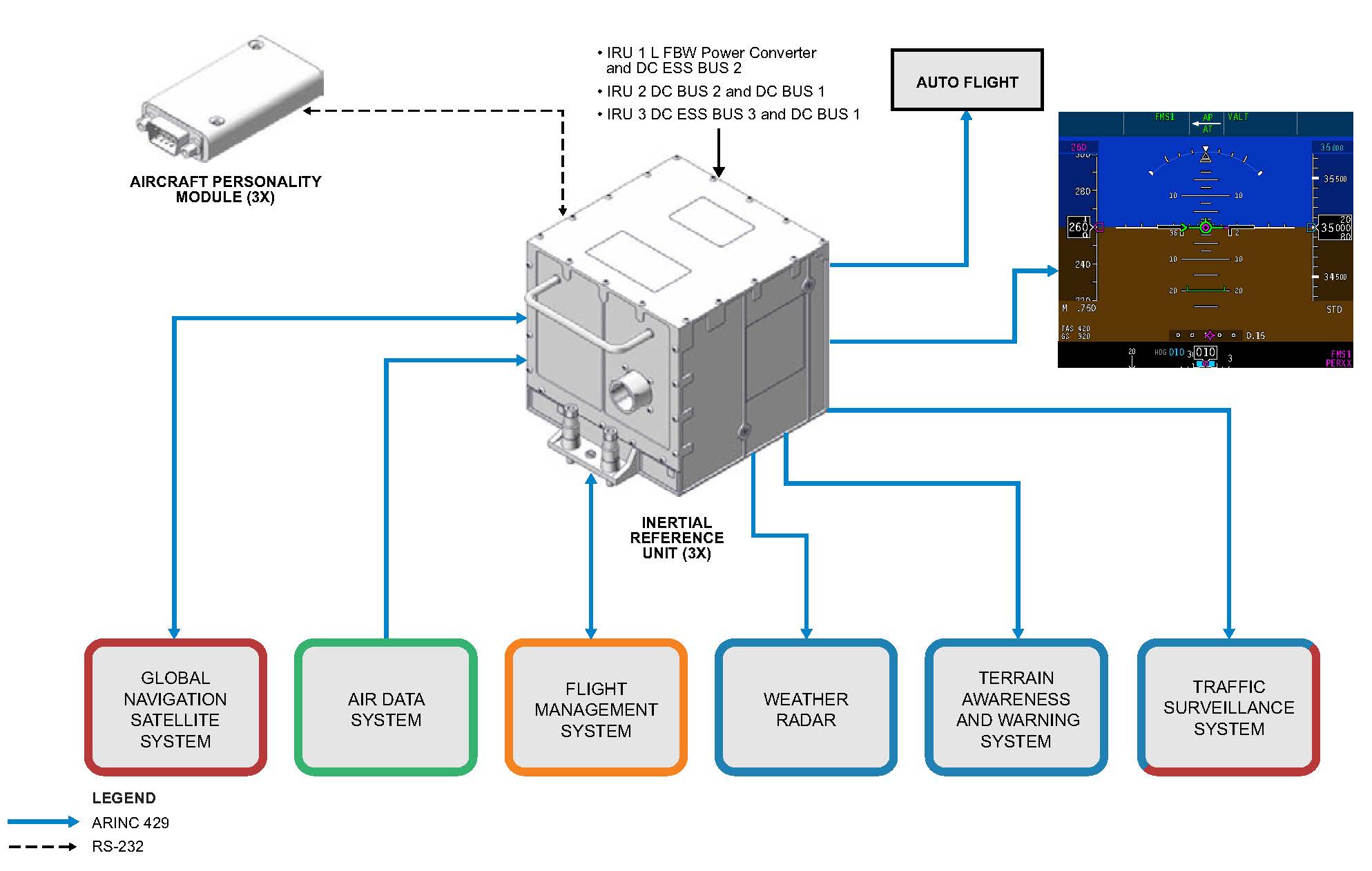
The heart of the system lies in three IRUs installed in the cockpit consoles. Each IRU:
- Performs Alignment
- During ground operations, stationary alignment ensures accurate heading and attitude references before takeoff. If the aircraft moves above 30 knots during alignment, the IRU switches to Align-in-Motion (AIM) mode.
- Provides Attitude and Heading
- After a successful alignment, each IRU enters navigation mode, delivering real-time pitch, roll, heading, and inertial position data.
- Interfaces with GNSS and Air Data
- The IRUs blend inertial data with satellite-based positioning and altitude information to form a hybrid navigation solution. This integrated approach reduces drift and maintains precise location estimates over extended flights.
- Retains Parameters in the Aircraft Personality Module (APM)
- The APM stores critical calibration and configuration data. If an IRU or its mounting tray is replaced, the new setup must be re-initialized or the APM erased to ensure alignment data remains valid.
Key Alignment Modes
- Stationary Alignment Mode:
- The standard ground-based alignment. Dependent on stable conditions with ground speed under 30 knots, lasting 3 to 17 minutes depending on latitude.
- Align-in-Motion (AIM) Mode:
- Required if the aircraft begins to move above 30 knots or if power is interrupted in flight. Uses valid GNSS data to align faster—within 10 to 20 minutes—restoring full navigational accuracy even when the aircraft is not stationary.
- Auto Realignment (AR) Mode:
- Automatically refines alignment when the aircraft is stationary on the ground while already in navigation mode. This helps maintain a high degree of precision over longer ground stops.
Redundancy and Reversion Logic
The Airbus A220 Inertial Reference System can handle multiple IRU failures without compromising flight safety:
- Three IRUs provide triple redundancy. In normal conditions, the left Primary Flight Display (PFD) uses IRS 1, while the right PFD uses IRS 2.
- IRS 3 serves as a spare. If an IRU fails, reversion happens automatically or manually via the Reversion Switch Panel (RSP).
- Dual Power Inputs for each IRU ensure one bus failure does not disable an entire inertial channel.
Flight Deck Integration
Pilots see IRS-based information on the Primary Flight Display (PFD) in the form of attitude (pitch/roll), heading, flight path vector, and slip/skid indicators. If alignment is ongoing, messages like ATT/HDG ALIGNING—DO NOT TAXI appear on the PFD, advising the crew to remain stationary or acknowledge a longer align-in-motion period. In flight, if an IRU fails, the flight deck alerts the crew with caution or advisory CAS messages (e.g., IRS 2 FAIL), and reversion instructions are clearly displayed.
Operational Advantages
- Enhanced Safety: Triple redundancy and multiple alignment modes maintain accuracy and reduce pilot workload.
- Rapid Recovery: Align-in-motion mode avoids extensive downtime if power is lost during taxi or flight.
- Seamless Integration: The IRUs interface with other key systems—GPS, air data, traffic surveillance, terrain awareness, and weather radar—reinforcing the A220’s advanced avionics suite.
Conclusion
In an environment where even small navigation errors can have significant implications, the Airbus A220 Inertial Reference System offers robust, fully integrated solutions for precise flight guidance. From automatic alignment modes to triple redundancy in power and hardware, the A220’s IRS underscores how modern aviation technology ensures consistent, reliable navigation data under all conditions.


