
Modern commercial jets rely on multiple layers of navigation technology to ensure accurate, reliable guidance from departure to touchdown. Among these technologies, the Airbus A220 VHF Navigation System plays a central role in providing pilots with essential approach and en-route information—covering everything from localizer (LOC) and glideslope (GS) signals to marker beacons and VOR references. By integrating a highly flexible tuning interface, robust fail-safes, and automatic channel selection, the VHF Navigation System streamlines pilot workload and ensures consistent performance even under challenging conditions.
A Quick Glimpse at the Evolution of VHF Navigation
The concept of Very High Frequency (VHF) radio navigation emerged alongside the dawn of civilian aviation. Early VHF systems centered on basic signals guiding aircraft to ground-based stations (VOR, for example). Over time, engineers refined these signals to provide more precise lateral and vertical references, culminating in systems like the instrument landing system (ILS). The Airbus A220 VHF Navigation System builds on these longstanding fundamentals, using advanced digital receivers and integrated control architecture to handle everything from everyday route changes to automated approaches.
Core Components
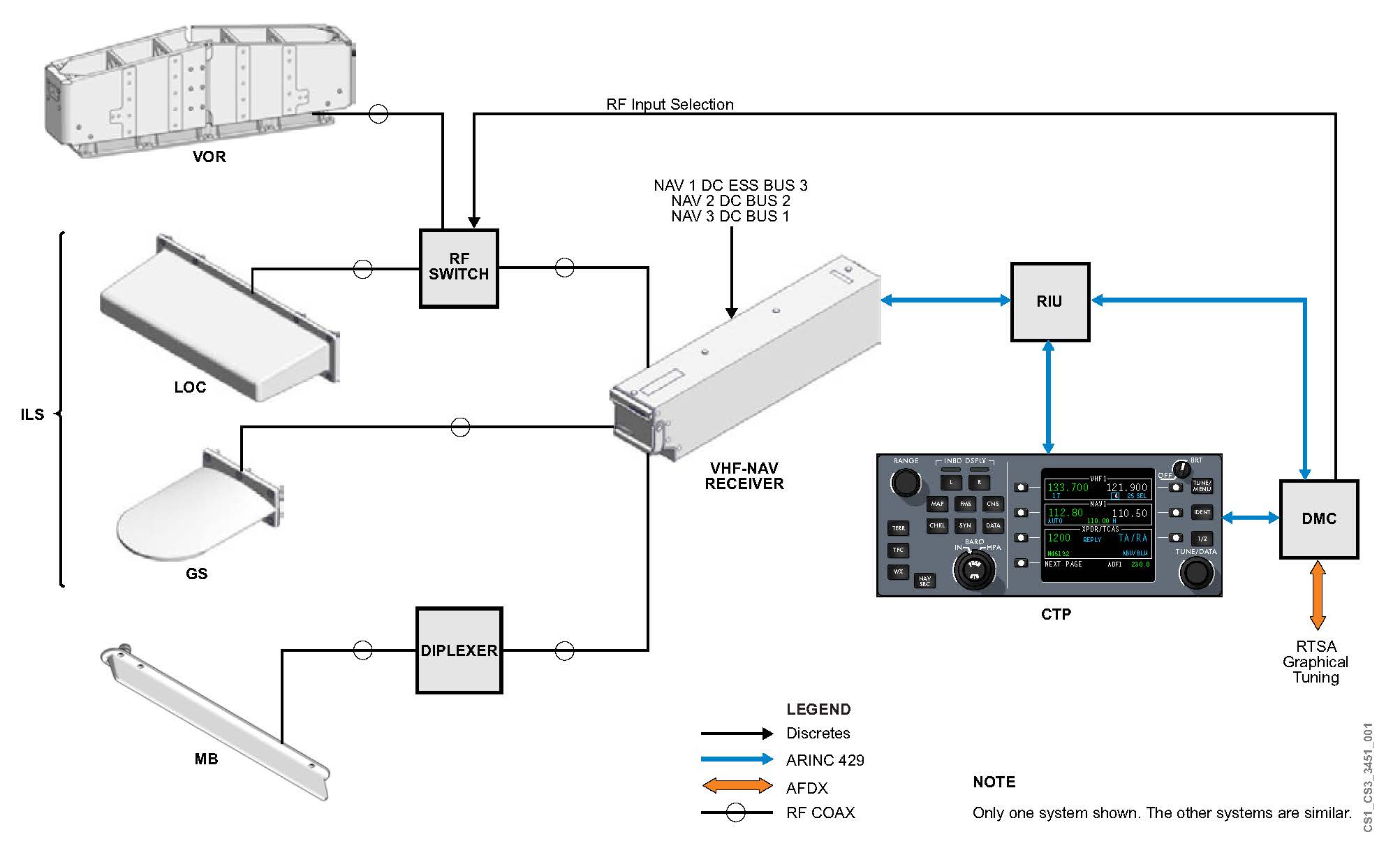
- VHF-NAV Receivers (1, 2, and Optional 3):
Each receiver can decode signals for VOR, localizer, glideslope, and marker beacons. By default, VHF-NAV 1 is powered by DC ESS BUS 3, VHF-NAV 2 by DC BUS 2, and the optional VHF-NAV 3 by DC BUS 1. This power distribution ensures that at least one receiver remains functional if a single bus fails. - Antenna Arrays:
The system draws signals from multiple antennas:- VOR Antenna inside the vertical stabilizer.
- LOC Antenna(s) in the radome.
- GS Antenna(s) below the radome.
- Marker Beacon Antenna on the lower fuselage.
Additional antennas may be fitted for Category IIIb operations.
- Radio Interface Unit (RIU) and RF Switches:
The RIU processes signals from the VHF-NAV receivers and coordinates them with flight deck displays and the audio system. Meanwhile, RF switches dynamically select between VOR and LOC antenna sources based on the tuned frequency. - Marker Beacon Diplexer:
This device splits the marker beacon signal so that both receivers can benefit from a single antenna, simplifying wiring and hardware needs.
Tuning and Display Options
Pilots have multiple ways to tune frequencies and manage navigation sources:
- Control Tuning Panels (CTPs):
Each pilot’s glareshield features a CTP for direct frequency entry. The VHF navigation channels appear on the panel’s display, which can also show status or fault information. - Radio Tuning System Application (RTSA) and Graphical Tuning:
Through the aircraft’s Data Concentrator Module (DMC) and integrated displays, pilots can set or adjust frequencies via on-screen menus. This includes advanced “graphical tuning,” letting them select navaids on a map display. - Automatic Flight Management System (FMS) Tuning:
For ultimate convenience, the FMS can auto-tune frequencies during pre-planned approaches or route changes. This reduces pilot workload and helps avoid potential manual tuning errors.
Flight Deck Integration
Once tuned, the VHF Navigation data appears on both the Primary Flight Display (PFD) and, when necessary, on the Standby Flight Instrument System (SFIS):
- Localizer and Glideslope Bars: Indicate lateral and vertical path deviations during ILS approaches.
- Marker Beacon Lights (OM, MM, IM): Appear on the PFD to confirm passing over outer, middle, or inner markers if used by the airport.
- Bearing Pointers: Show bearing to a chosen navaid, such as VOR or ADF (if fitted).
- Source Labels: Color-coded to distinguish onside and cross-side references.
Reliability and Self-Testing
The Airbus A220 VHF Navigation System continuously validates data, flagging any suspicious or failed signals. Pilots see caution messages on the flight deck and fail flags on instruments if the system detects no computed data (NCD) or an internal malfunction (FW). A built-in test feature, accessed via the CTP or RTSA, allows crews to confirm correct functionality in under 10 seconds—replicating familiar navaid references (like a 100 NM DME) to show each channel is working.
Looking Ahead
Though satellite-based navigation continues to expand, VHF-based systems remain integral, especially for precision landings under low visibility or as backups to emerging technologies. The Airbus A220 VHF Navigation System combines proven reliability with modern interfaces—ensuring pilots can seamlessly access everything from en-route VOR radials to Category IIIb precision approaches. In a dynamic airspace environment, robust systems like these remain the cornerstone of safe and efficient commercial aviation.


