
Accurate air data forms the backbone of safe and efficient flight operations. The Airbus A220 Air Data System represents a major leap forward in how jets collect, process, and distribute critical flight information like airspeed, altitude, and temperature. By pairing multiple Air Data Smart Probes (ADSPs) with supplementary sensors—like angle-of-attack vanes and total air temperature probes—this next-generation system ensures pilots receive reliable, highly accurate data at every phase of flight.
Evolution of Air Data Technology
Historically, separate pitot tubes, static ports, and analog instruments gave pilots a rough idea of velocity, altitude, and climb rate. Over time, these analog devices gave way to digital air data computers, which consolidated and refined pressure measurements. Today’s Airbus A220 Air Data System integrates both the sensor and computing elements into each ADSP, greatly streamlining architecture and improving reliability. This evolution underscores how modern aircraft continue to reduce mechanical linkages and single points of failure, instead favoring integrated, software-driven solutions.
Core Components and Functions
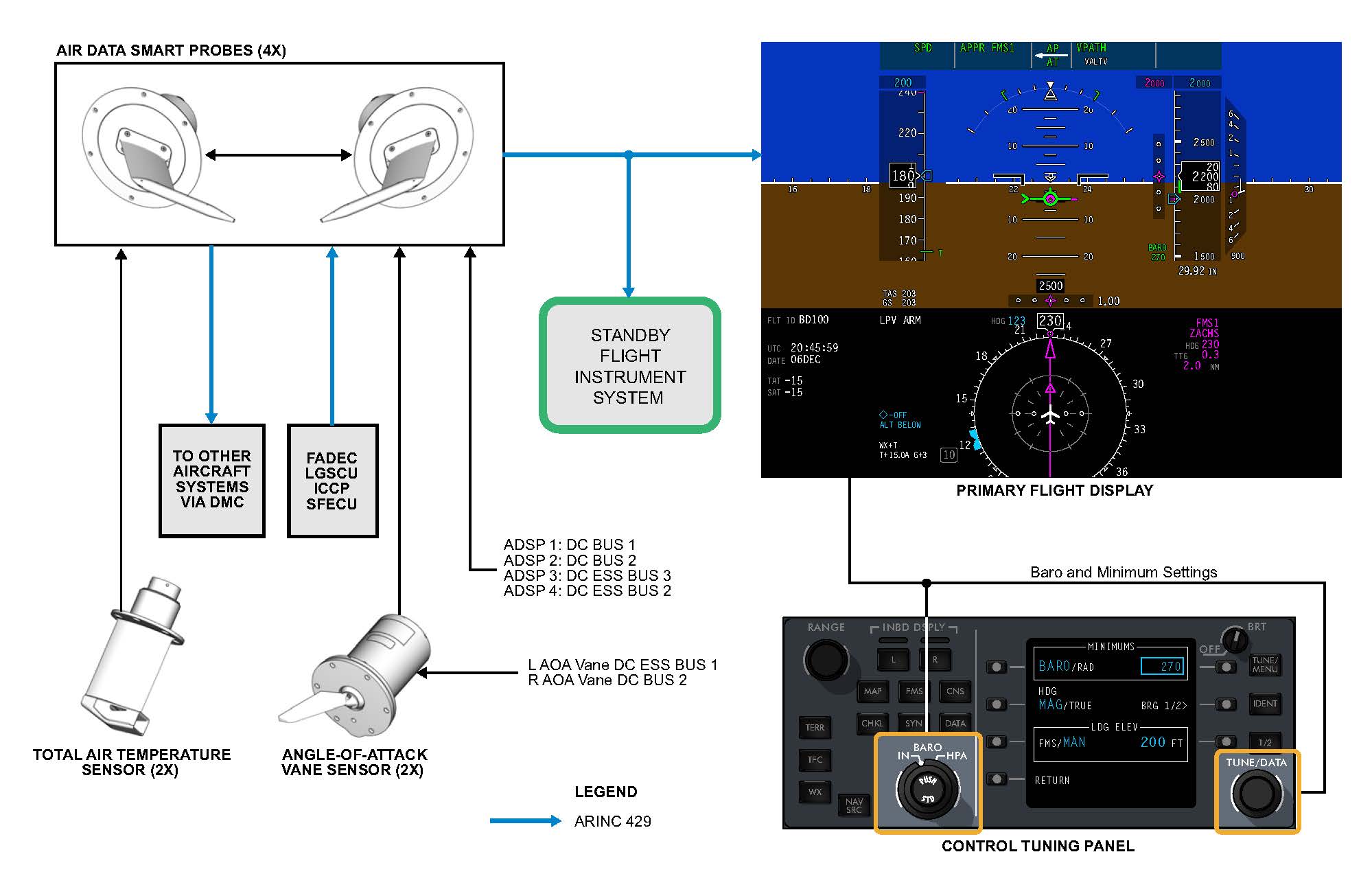
At the heart of the Airbus A220 Air Data System are four ADSPs mounted on the nose fuselage, each combining a multifunction probe and a dual-channel air data computer. These probes measure:
- Total and static pressure to determine altitude, indicated airspeed (IAS), and Mach number.
- Angle of attack (AOA) data, factoring in input from separate AOA vanes for redundancy and cross-checking.
- Total air temperature (TAT), which is converted into static air temperature (SAT) for performance calculations.
Each probe communicates with others to correct for side-slip effects. If the system detects a problem with one sensor, it can switch to an alternate data source—like an engine TAT sensor—maintaining the highest fidelity of results. This approach not only enhances reliability but also reduces the chance of spurious readings that could affect the flight management system or autopilot.
Redundancy and Safety Benefits
Beyond collecting accurate measurements, the Airbus A220 Air Data System emphasizes robust redundancy. By employing four distinct ADSPs spread across separate power buses, the aircraft can withstand multiple failures without losing critical data:
- Independent Power Feeds:
Each ADSP is powered by a different DC bus, ensuring an electrical fault in one bus does not disable the entire system. - Cross-Probe Comparisons:
If an ADSP’s opposite-side static pressure reading is lost, it can revert to estimated beta signals from the flight guidance system, maintaining reliable side-slip compensation. - AOA Miscompare Logic:
The system monitors differences between vane AOA and smart probe AOA. If readings diverge significantly under normal flight conditions, it alerts the crew, signaling potential sensor or heater issues. - Heater and TAT Redundancy:
If a fuselage TAT sensor becomes invalid or fails, the ADSP automatically switches to engine TAT data. Probe heaters further guard against icing, and each ADSP heater is monitored continuously for any malfunction.
Flight Deck Integration
Data from the Airbus A220 Air Data System flows directly to the primary and standby flight displays, enabling real-time updates of altitude, airspeed, Mach, and temperature. In normal modes, ADSP 1 feeds the left PFD, ADSP 2 drives the right PFD, and ADSP 3 supplies the standby instruments. If any channel fails, pilots can quickly revert to a spare source via the reversion switch panel. Clear CAS messages (e.g., “ADS 1 FAIL” or “ADS PROBE HEAT FAIL”) prompt the flight crew to take decisive action, while the Onboard Maintenance System (OMS) stores detailed fault data for ground-based diagnostics.
Looking Ahead
As commercial aircraft continue to embrace increasingly digital systems, the Airbus A220 Air Data System stands out as a model of efficiency, accuracy, and fault tolerance. By unifying hardware, software, and multiple sensor streams, it delivers high-integrity data that fosters safer, more precise flight. Whether it’s optimizing climb rates or fine-tuning landing approaches, an advanced air data system underpins nearly every aspect of modern airline operations—helping operators meet rising standards for performance and reliability in an ever-busy sky.


