
LRD
$23,783.25
Online Aviation Technology Continuation Training for helicopter maintenance engineers and rotary-wing technical personnel. Covers HUMS, predictive maintenance, artificial intelligence, fly-by-wire flight controls, advanced avionics, sustainable propulsion and emerging autonomous rotorcraft technologies, supporting EASA, UK CAA and FAA continuation/recurrent training programmes.
The Aviation Technology – Rotary Wing course provides helicopter maintenance engineers and aviation technical personnel with an understanding of the latest developments in rotorcraft technology, maintenance practices and aviation safety systems.
As modern helicopters incorporate increasingly sophisticated avionics, digital flight controls, health monitoring systems and automated technologies, maintenance personnel must remain familiar with emerging developments and their implications for aircraft reliability, continuing airworthiness and operational safety.
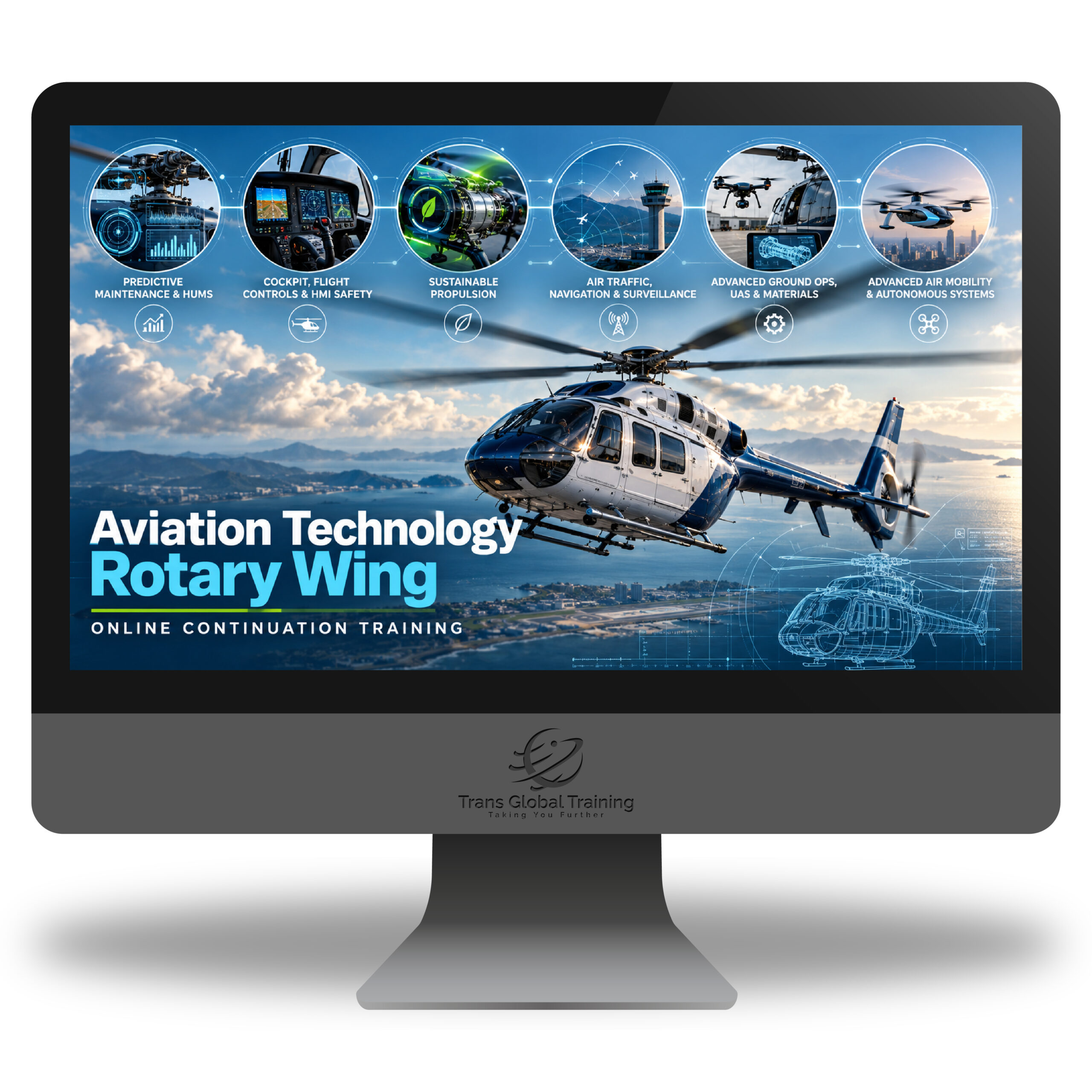
This online course examines predictive maintenance, Health and Usage Monitoring Systems (HUMS), artificial intelligence, fly-by-wire flight controls, sustainable propulsion, advanced navigation and surveillance systems, and emerging autonomous rotorcraft technologies.
Real-world aviation case studies demonstrate how technological developments influence maintenance activities, fault diagnosis and flight safety.
The course has been developed to support the aviation technology element of continuation and recurrent training programmes under EASA, UK CAA and FAA maintenance regulations.
The course comprises six modules:
1. Predictive Maintenance & Data Management
Explores the application of big data, artificial intelligence and predictive analytics in aircraft maintenance. Particular attention is given to rotorcraft Health and Usage Monitoring Systems (HUMS), vibration monitoring, component condition assessment, digital twins and the use of operational data to identify developing faults.
2. Cockpit Environments, Flight Controls & Human-Machine Interface Safety
Examines the interaction between mechanical components, cockpit interfaces and digital aircraft systems. Covers the evolution of helicopter flight controls, fly-by-wire technology, flight envelope protection, system redundancy, sensor calibration and software configuration control. Includes a case study examining the safety implications of unintended physical inputs into automated flight-control systems.
3. Sustainable Propulsion & Powerplants
Introduces emerging propulsion technologies, including open-fan engine architecture, hybrid-electric propulsion, hydrogen fuel systems, sustainable aviation fuels and fully electric aircraft. Explores the engineering principles and technical challenges associated with integrating new propulsion technologies into aviation.
4. Future Air Traffic, Navigation & Surveillance Systems
Examines developments in radio altimeter interference protection, ACAS X collision avoidance, ADS-B surveillance and next-generation air traffic safety systems. Includes consideration of ACAS Xr, developed specifically for rotorcraft and emerging electric aircraft applications.
5. Advanced Ground Operations, Structural Systems & Materials
Explores modern airport and ground safety systems, automated aircraft inspections using unmanned aerial systems, artificial intelligence-assisted defect identification, augmented reality maintenance applications and additive manufacturing of aircraft components.
6. Advanced Air Mobility & Autonomous Mission Systems
Introduces the technologies supporting the next generation of rotorcraft and autonomous aircraft, including electric vertical take-off and landing (eVTOL) aircraft, distributed electric propulsion, high-voltage battery management, autonomous helicopters and unmanned cargo platforms. Also examines advanced sensor systems, autonomous flight control, high-voltage electrical safety and emerging maintenance requirements.
The course also provides links to aviation industry and regulatory resources containing regularly updated information on aircraft incidents, service developments and continuing airworthiness.
These include access to EASA and UK CAA Airworthiness Directives and other relevant technical publications, helping learners maintain awareness of emerging safety issues and developments affecting aircraft maintenance.
This course has been developed to support the aviation technology element of continuation/recurrent training requirements under:
The course may contribute towards the continuation and recurrent training programmes of maintenance organisations operating under EASA, UK CAA and FAA regulatory requirements.
The course is suitable for licensed helicopter maintenance engineers, aircraft mechanics, avionics technicians, maintenance supervisors, technical support personnel, CAMO staff and other aviation professionals seeking to maintain their knowledge of developments in rotary-wing aircraft technology.
It is particularly relevant to personnel employed by Part-145 maintenance organisations, helicopter operators and other rotorcraft maintenance providers.
Upon completion, participants will have developed an understanding of:
Trans Global Training specialise in providing online self-study courses for technical personnel like technicians, CAMO staff, and other aviation professionals seeking to enhance their expertise. Our comprehensive programs are designed to deepen your knowledge in aircraft maintenance and airworthiness management. With a focus on practical, up-to-date information, our courses allow you to learn at your own pace, anytime and anywhere.
Empower yourself with the skills needed to excel in the ever-evolving aviation industry. Join us today to advance your career and stay ahead in the field of aviation technical services.


Our Bespoke Training Solutions allow you to create customized courses that align perfectly with your organization’s goals. Simply provide us with your training materials, and we’ll develop a program that meets your exact requirements.